
Industrial inverter selection should begin with the load profile. Rated power matters, but startup current, waveform quality, transfer function, battery setup, and site conditions often decide whether the system runs smoothly.
Founded in 2007, ZLPOWER supplies UPS power products, power inverters, solar inverters, EPS power supplies, and related power solutions. Its product range includes both low frequency and high frequency inverter options for industrial and commercial backup power projects.
Industrial loads do not behave like simple lighting or office devices. Motors, pumps, compressors, fans, and CNC support systems may draw much higher current during startup than during normal running. That short surge is where many inverter sizing mistakes show up.
A pump may run at moderate power after starting, but the first few seconds are harder. An HVAC compressor may cycle repeatedly in a hot workshop or equipment room. CNC controllers and support loads may need stable pure sine wave output for control boards, drives, and auxiliary devices.
Common field issues include failed startup, voltage sag, overload trips, abnormal motor noise, controller reset, or unexpected shutdown. For B2B projects, these faults can mean lost output, service visits, delayed delivery, or extra replacement cost.
Many procurement errors happen when sizing is based only on running watts. Motor-type loads often need several times their normal running power at startup. Exact values depend on the motor, starting method, load condition, and site wiring. Running power alone is not enough for industrial inverter selection.
For CNC equipment, HVAC control boards, pumps, and motor-driven systems, pure sine wave output is usually preferred. It helps reduce compatibility issues, heat, noise, and unstable operation compared with lower-grade waveform output.
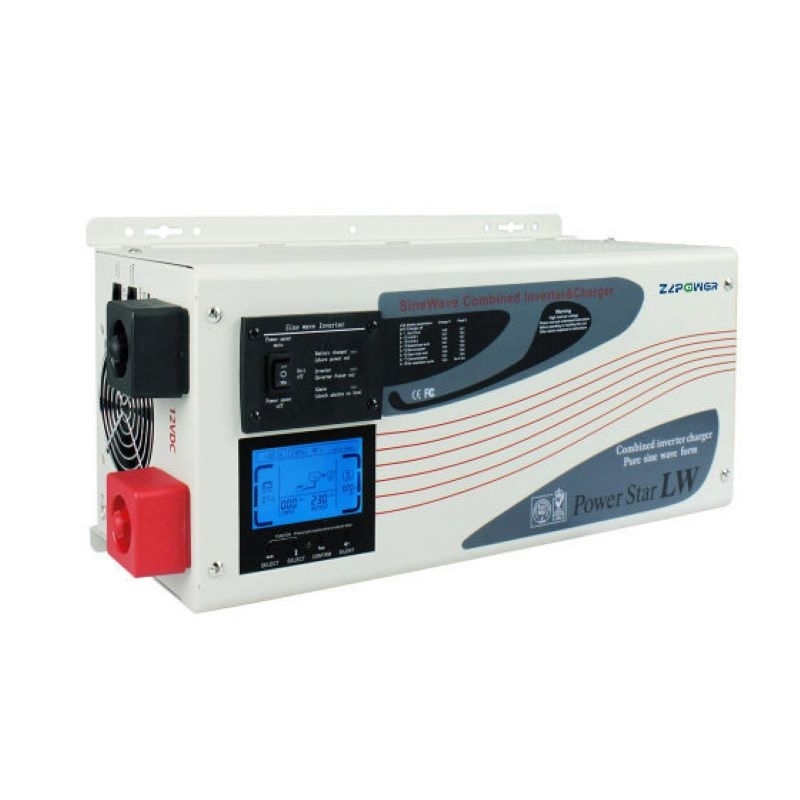
A low frequency inverter usually uses a transformer-based design. It is larger and heavier, but the extra size often brings stronger surge tolerance. For heavy inductive loads, that margin can be useful.
ZLPOWER’s LW Series Pure Sine Wave Inverter is a relevant product direction for this type of application. The LW series is listed as a low frequency inverter with transformer, LCD display, UPS function, pure sine wave output, and three times peak power. The product information also mentions use with inductive loads such as air conditioners and motors.
A low frequency inverter may cost more and take more cabinet space, so it should be selected when the load profile justifies the extra surge margin.
|
Load Type |
Common Risk |
Selection Reason |
|
Pumps |
High startup current |
More surge margin during motor start |
|
HVAC systems |
Compressor cycling |
Better tolerance for repeated starting demand |
|
Motors |
Starting torque demand |
Transformer design can support tougher load behavior |
|
CNC-related control and auxiliary loads |
Control boards, auxiliary devices, and selected drive loads may be sensitive to power quality |
Pure sine wave output and UPS function may help support stable operation after proper load review |
|
Mixed workshop loads |
Several devices may start together |
More room for load fluctuation after proper sizing |
A high frequency inverter is usually smaller and lighter. It can be a practical fit when space, solar charging, efficiency, and installation convenience carry more weight than heavy surge demand.
ZLPOWER’s PVG High Frequency Solar Inverter series includes 3.5KW, 5.2KW, and 5.5KW models. The product information lists pure sine wave output, built-in MPPT solar charge controller, high PV input voltage range, battery independent design, operation without battery, and a built-in MPPT solar charger.
This type of high frequency inverter is more suitable for:
· Commercial solar backup systems
· Network and communication equipment rooms
· Office or shop backup power
· Lighting and light-duty AC loads
A high frequency inverter can be the right choice when the load is stable and well defined. It should not be chosen only because it is compact if the real application includes heavy motors, pumps, or compressors.
|
Selection Point |
Low Frequency Inverter |
High Frequency Inverter |
|
Better fit |
Heavy inductive loads |
Solar backup and lighter commercial loads |
|
Typical loads |
Pumps, motors, HVAC, compressors, CNC support |
Network equipment, lighting, office equipment, light AC loads |
|
Size and weight |
Larger and heavier |
Smaller and lighter |
|
Surge handling |
Usually stronger |
Depends on model and sizing |
|
Main project value |
Startup reliability and overload margin |
Space saving, solar input, easier installation |
|
Buying risk |
Oversized for light loads |
Possible trips if used for heavy motor loads |
This comparison should be used as a project guide, not a fixed rule. A pump station and a solar backup cabinet for office equipment should not follow the same buying logic.
A useful RFQ should include more than voltage and rated power. Better load data helps suppliers recommend a safer industrial inverter solution and reduces communication delays.
· Load type: resistive, electronic, or inductive
· Rated power and startup current, if available
· Voltage, frequency, and required runtime
· Battery voltage, battery type, and charging current
· Solar input range or MPPT requirement
· Generator input requirement, if any
· UPS function or transfer time requirement
· Installation environment, including heat, dust, cable length, and grid stability
Product specifications should be confirmed with the latest datasheet before final ordering, especially for mixed-load or project-based systems.
|
Mistake |
Possible Result |
|
Sizing only by running watts |
Motor may fail to start |
|
Ignoring waveform quality |
CNC or HVAC controls may behave unstably |
|
Choosing a compact model for heavy loads |
Overload trips during startup |
|
Sending incomplete RFQ data |
Wrong model recommendation |
|
Comparing only unit price |
Higher service cost after installation |
Industrial sites are rarely as clean as a datasheet. Dust, heat, weak grid voltage, long cable runs, and mixed loads can all affect inverter temperature, transfer stability, and long-term service life.
ZLPOWER LW Series low frequency pure sine wave inverters fit projects where transformer design, UPS function, and three times peak power are important. They can be considered for motor-related loads such as pumps, air conditioners, and workshop backup systems after proper sizing.
ZLPOWER PVG high frequency solar inverter models fit solar backup applications where MPPT charging, pure sine wave output, compact design, and battery flexibility are important. They are more suitable for lighter commercial systems than heavy motor-starting projects.
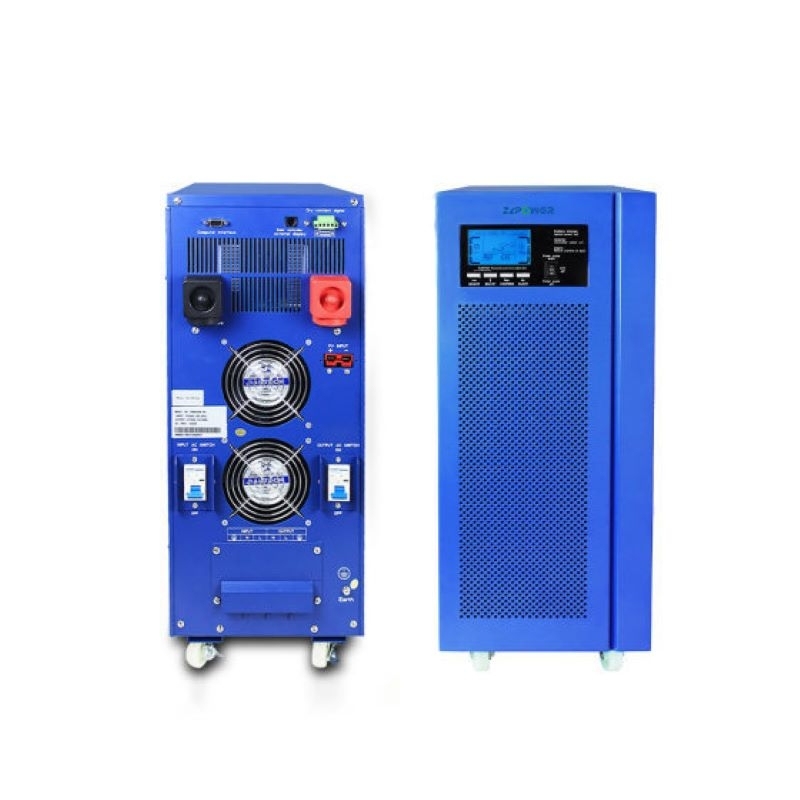
For projects requiring higher single-phase capacity, ZLPOWER’s PW Series 8KW, 10KW, and 12KW pure sine wave inverters can also be reviewed as part of the model selection process. The series includes AC/DC mode setting, overload protection, and output short-circuit protection.
Choosing between a low frequency inverter and a high frequency inverter should begin with real load behavior. For pumps, HVAC systems, compressors, motors, and CNC support loads, startup current and stable pure sine wave output often matter more than compact size. A low frequency inverter is often preferred for heavy inductive loads, while a high frequency inverter can be a better match for compact solar backup, network equipment, office loads, and lighter commercial systems.
As an industrial inverter supplier, ZLPOWER offers low frequency inverter chargers, high frequency solar inverters, UPS products, and related power solutions for industrial and commercial projects. Buyers can send the load list, startup current, runtime, voltage, battery type, generator input, and application scenario to ZLPOWER for model matching and quotation support.
Q1: How should an industrial buyer size an inverter for pumps, HVAC or compressors?
A: The inverter should be sized by both running power and startup current. Pumps, HVAC units, and compressors may need several times their normal running power during startup, so rated wattage alone is not enough.
Q2: What information should be sent to ZLPOWER before requesting a quotation?
A: Buyers should provide load type, rated power, startup current if available, voltage, frequency, runtime, battery type, generator input requirement, installation environment, and whether UPS transfer is needed.
Q3: Is a low frequency inverter better for motor-driven industrial loads?
A: For motors, pumps, compressors, and many HVAC systems, a low frequency inverter is often preferred because transformer-based designs usually offer stronger surge tolerance.
Q4: When is a high frequency inverter a better choice?
A: A high frequency inverter is usually a better fit for compact solar backup, network equipment, office loads, lighting, and other light commercial systems where space, efficiency, and MPPT charging matter more than heavy motor startup.
Q5: Can ZLPOWER help select an inverter for mixed industrial loads such as CNC support equipment, pumps and lighting?
A: It may be possible, but the inverter should be sized according to the highest startup demand and the total simultaneous load. For mixed industrial loads, ZLPOWER can review the load list before recommending a suitable model.
 ChatNow
 Vania
Vania