
An EPC team pricing a 4–6 kW off-grid project usually reaches the battery-voltage question before the purchase order: 24 V or 48 V? The choice affects DC cable size, breaker ratings, battery layout, installation labor, and sometimes the margin on the job.
For a distributor repeating the same package across many installations, that choice appears on every bill of materials. Buyers comparing a solar inverter supplier need to look beyond wattage and check how the full DC system will be sourced, installed, and supported.
Founded in 2007, ZLPOWER develops low- and high-frequency inverter products for off-grid and hybrid applications. This guide compares the purchasing factors behind a 24V solar inverter and a 48V solar inverter.
Battery current can be estimated as:
DC input current ≈ AC load power ÷ battery voltage ÷ inverter efficiency
For a 4 kW load and 90% conversion efficiency, estimated current is about 185 A at 24 V and 93 A at 48 V. Actual current changes with battery voltage and operating efficiency, but doubling the voltage roughly halves the current at the same power.
That difference affects cable cross-section, voltage drop, terminal temperature, and fuse or breaker ratings. A battery cabinet beside the inverter is one thing. A farm project with several meters of DC cable is another; that is where copper cost starts to show up.
Lower current does not mean every 48 V inverter has better conversion efficiency. It simply makes high-current DC design easier to manage.
A 24 V bank may use two compatible 12 V modules in series, while a 48 V bank may use four. Purpose-built 24 V and 48 V lithium packs are also common.
Series connection must be approved by the battery manufacturer, especially for batteries with an integrated BMS. Before ordering, confirm:
· Approved inverter DC-input range
· Battery charging and low-voltage limits
· Continuous and peak battery current
· BMS communication protocol
· Firmware requirements
· Permitted series and parallel arrangements
Matching voltage labels is only the first check.
A 24V solar inverter can suit moderate loads, short cable runs, and limited expansion. Typical projects include small offices, farm buildings, security stations, mobile service units, telecom cabinets, and light commercial backup.
Where compatible 12 V or 24 V batteries are widely stocked, the package may also be easier to source. This can help an off-grid inverter supplier cover smaller projects without carrying too many battery formats.
As power rises, higher current may require heavier cable, larger protection devices, stronger terminals, and more labor. The inverter may look cheaper on the quotation, yet the installed system is not.
For a repeat or bulk order, compare the complete BOM. A small cable-cost difference becomes significant when the same package is shipped in volume.
· Inverter and battery modules
· DC cables and busbars
· Fuses, breakers, and isolators
· Battery cabinet
· Installation labor
· Local spare parts
Projects still working through load capacity can refer to ZLPOWER’s guide to selecting the right inverter capacity for B2B projects before fixing the battery voltage.
A 48V solar inverter is commonly selected for larger battery banks, longer backup time, and moderate-to-high-power off-grid loads. Farms with pumps, refrigeration sites, workshops, remote facilities, and small factories are typical examples.
Motor loads still need a separate surge review. Moving to 48 V does not give the inverter more starting capacity by itself; surge performance comes from the selected model.
A 48 V platform reduces DC current as system power grows, but voltage alone does not define expansion capacity. Buyers still need to check inverter current limits, BMS rules, approved battery quantity, charging power, communication, and firmware.
For distributors planning one OEM solar inverter platform across several battery capacities, the approved battery arrangement, replacement procedure, and technical datasheet matter as much as nominal voltage.
|
Procurement factor |
24 V system |
48 V system |
|
Typical project |
Compact and moderate loads |
Moderate and higher-power loads |
|
DC current |
Higher at equal power |
Roughly half |
|
Cable design |
More demanding as power rises |
Often easier at higher power |
|
Battery sourcing |
Useful where 12 V or 24 V modules are common |
Common for larger storage systems |
|
Distributor positioning |
Compact and entry-level packages |
Commercial and scalable packages |
|
Main decision factors |
Load, cable run, and battery design |
Load, current, storage, and expansion |
Two 5 kW projects can behave very differently. One may run lighting and computers; another may start a pump several times a day. Review continuous load, surge demand, backup hours, usable battery capacity, cable length, PV charging power, and future loads before choosing a voltage platform.
The ZLPOWER PVM hybrid inverter product table identifies the PVM3500-24 and PVM5500-48. Both use pure sine wave output and a built-in 100 A MPPT solar charger.
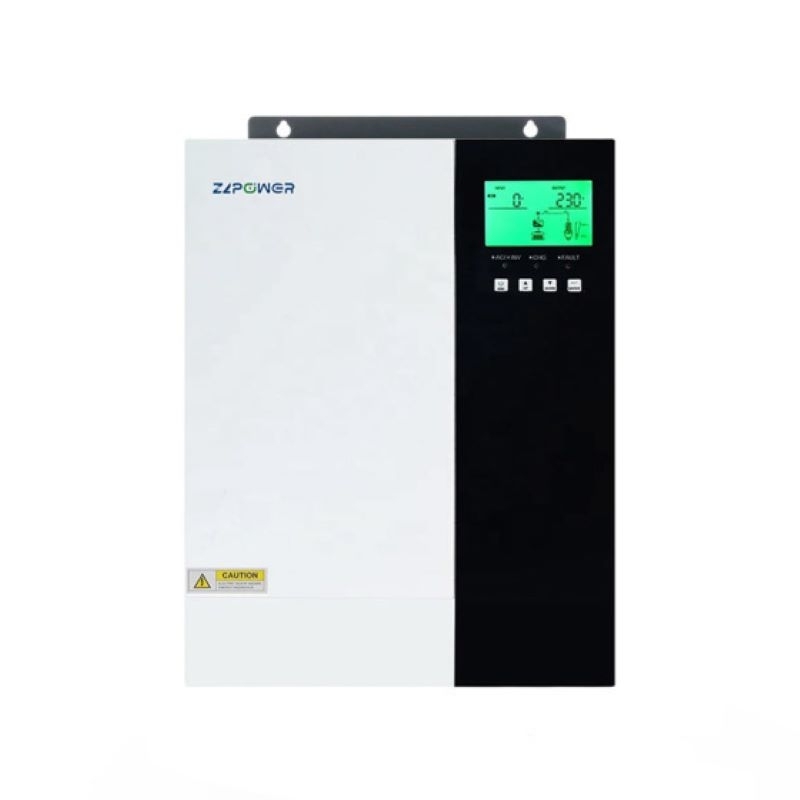
The product also provides configurable battery-charging current, AC or solar charging priority, and dual outputs for separating critical and non-critical loads. These models give project buyers a direct comparison: 3.5 kW on a 24 V platform and 5.5 kW on a 48 V platform. Confirm the battery voltage of other PVM ratings by exact model before ordering.
The ZLPOWER GS 4–6 kW low-frequency inverter series includes 4 kW, 5 kW, and 6 kW models with 24 V and 48 V configurations across the family.
Published specifications include a 60 A MPPT solar charger, five adjustable AC charging-current stages, and three-times surge power for ten seconds. That makes the series relevant to pumps, compressors, refrigeration, and similar loads, but the selected rating and battery voltage still need to match the actual load schedule.
The ZLPOWER PVG hybrid inverter range includes three clearly identified configurations:
· PVG 3500-24: 3.5 kW with 24 V battery input
· PVG 5200-48: 5.2 kW with 48 V battery input
· PVG 5500-48: 5.5 kW with 48 V battery input
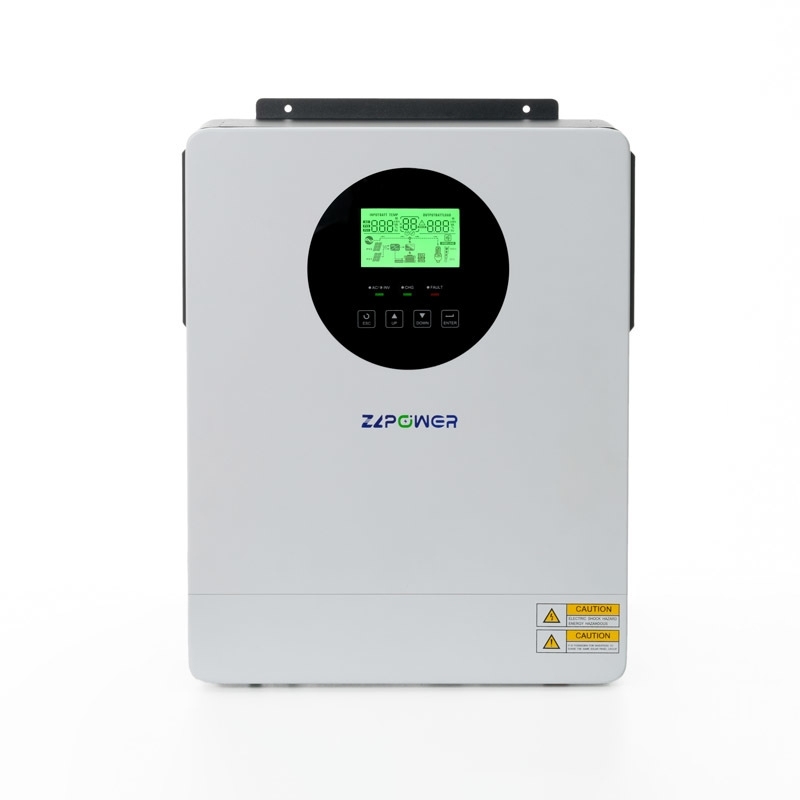
The series uses pure sine wave output, a built-in 100 A MPPT solar charger, high-voltage PV input, and battery-independent operation.
Battery-independent operation can help in solar-first or staged commissioning projects, but it is not battery backup. Stored-energy support still requires a correctly sized and compatible battery bank.
Send the solar inverter supplier:
· Continuous load and starting demand
· Required backup time
· Battery chemistry, voltage, and usable capacity
· Maximum charge and discharge current
· PV array power and voltage
· DC cable length
· AC voltage, frequency, and phase
· Site temperature and altitude
· Planned battery or load expansion
For a sample order, bulk order, or private-label program, confirm:
· Destination market and required certifications
· Order quantity and production lead time
· OEM logo, enclosure, and packaging requirements
· Display language
· Warranty terms
· Spare-parts availability
· Installer training and after-sales procedures
A complete RFQ reduces repeated emails and usually produces a faster, more accurate commercial quotation.
For a compact site with short DC runs, 24 V may keep the BOM simple and the initial package cost under control. Once battery capacity, cable distance, motor loads, or expansion plans increase, a 48 V platform is usually easier to engineer. There is no useful shortcut, though—the approved inverter model and battery data still decide the final configuration.
ZLPOWER can review specifications for distributors, EPC contractors, system integrators, and OEM buyers. Send the load list, backup requirement, battery and PV data, destination market, order quantity, and branding needs to request a model recommendation, technical datasheet, and solar inverter quotation.
A: DC current is the main difference. At equal power, a 48 V system carries roughly half the current of a 24 V system, which affects cable size, voltage drop, and protective-device ratings.
A: No. Lower current can reduce wiring losses, but inverter efficiency still depends on the model, load level, battery voltage, and operating conditions.
A: Many 5 kW systems use 48 V because the lower current makes DC wiring easier to manage. Surge demand, battery limits, cable distance, and the approved inverter model still determine the final configuration.
A: Not through a direct connection. The battery bank must remain within the inverter’s approved DC-input range; an incompatible voltage can prevent startup or damage the equipment.
A: Provide the load list, starting demand, backup hours, battery and PV specifications, AC output requirements, installation conditions, destination market, quantity, and OEM needs. Complete project data usually leads to a faster model recommendation and a more accurate quotation.
 ChatNow
 Vania
Vania